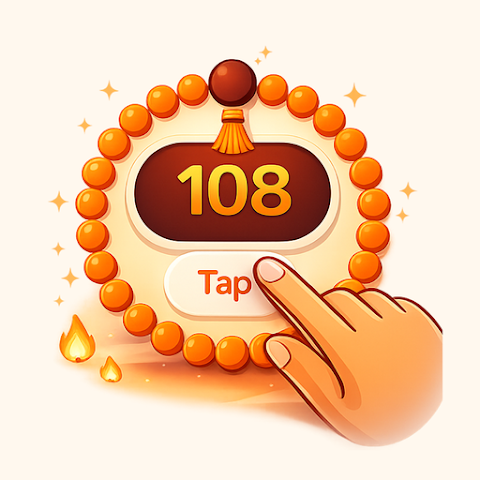

Pick up almost any tulsi or rudraksha mala and you will count 108 beads plus one larger bead. Why this number? The traditional answers weave together astronomy, scripture and practical wisdom.
Traditional meanings of 108
There is no single "official" reason. Instead, 108 appears in many places in Indian thought, and teachers often point to several of them together:
- Zodiac and planets: 12 rashis (zodiac signs) × 9 grahas (navagraha) = 108.
- Nakshatras: 27 lunar mansions × 4 padas (quarters) = 108.
- Upanishads: the Muktika Upanishad lists 108 Upanishads.
- Divine names: many deities have an Ashtottara Shatanamavali — a hymn of 108 names.
- Numbers: 1 × 2² × 3³ = 108, and 1 + 0 + 8 = 9, a number often considered complete.
Whatever the explanation you prefer, using the same number every day gives your practice a clear, repeatable unit — one mala — which makes it easy to keep a daily commitment.
The Sumeru (guru) bead
The extra bead is called Sumeru, after the sacred mountain at the centre of the universe in Indian cosmology. It is often linked with the guru and marks the start and end of one round. In many traditions you do not jump over it — when you reach it, you turn the mala around and begin the next round in the other direction.
The beads keep the count; the heart keeps the Name.
Malas of 27 and 54 beads
Smaller malas are also common, especially as wrist malas. A 54-bead mala is turned twice and a 27-bead mala four times to complete 108. They are easier to carry, but the count is the same.
How to count a mala correctly
Customs vary between traditions, but these guidelines are widely followed:
- Hold the mala in the right hand, draped over the middle or ring finger.
- Use the thumb to move one bead towards you with each repetition.
- Avoid using the index finger, which is traditionally associated with ego.
- Keep the mala off the floor and store it in a cloth bag (gomukhi) when not in use.
- Treat your mala with respect — many devotees use one mala only for jap.
Counting 108 the digital way
When you are travelling or at work, carrying a mala is not always practical. A digital counter such as the Naam Jap app keeps the same 108 structure: it shows your count, adds a mala to your total at 108 and records your progress for the day. You can also choose smaller targets of 27 or 54 if you prefer. Read our comparison of digital vs physical jap mala to choose what suits you, or start with What is Naam Jap? if you are new.
Frequently asked questions
What is the Sumeru bead?
The Sumeru (or guru bead) is the larger extra bead where the mala begins and ends. In many traditions you do not cross it; you turn the mala around and continue in the opposite direction.
Is one mala always 108?
One full mala is counted as 108 repetitions. Smaller malas of 54 or 27 beads are also used — you simply go round them two or four times to complete 108.
Why do some people count only 100 for each mala?
A commonly given explanation is that the extra 8 cover any mistakes or lapses of attention, so that at least 100 complete repetitions are offered.
Ready to start your practice?
Free mantra counter for your daily Naam Jap — rated 4.6★ on Google Play.