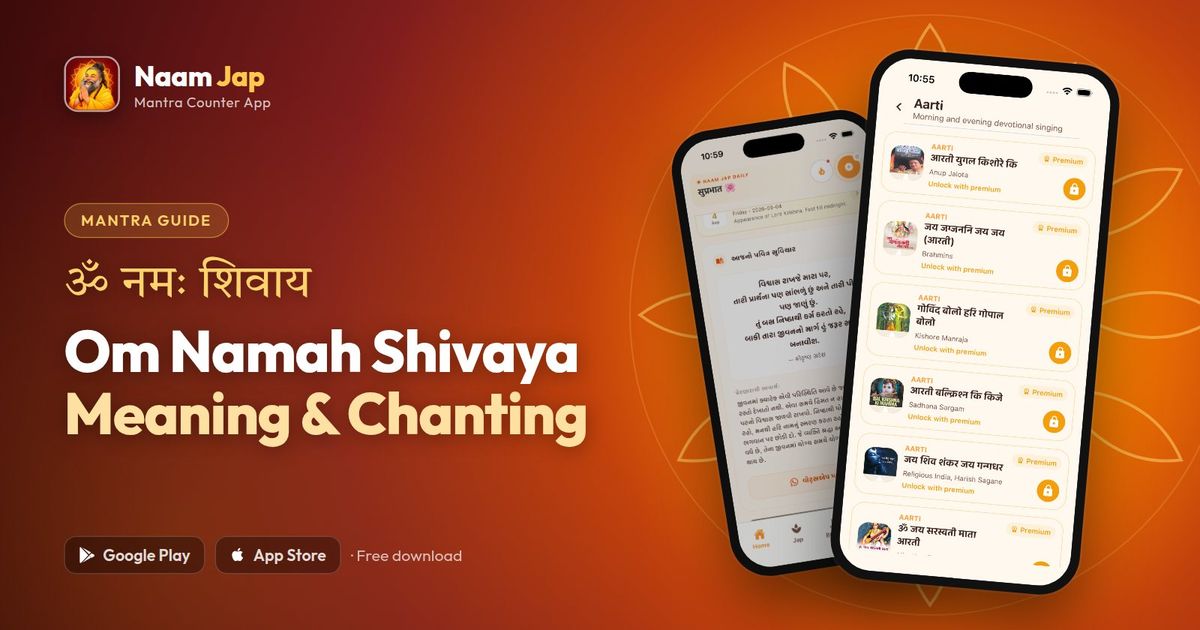
"Om Namah Shivaya" is one of the most widely chanted mantras in Hinduism. It is short, easy to remember and, for Shiva devotees, full of meaning. Here is a simple guide to understanding and chanting it.
The meaning of Om Namah Shivaya
- Om: the primordial sound, representing the Absolute.
- Namah: "I bow" — an expression of surrender and humility.
- Shivaya: "to Shiva" — the auspicious one, the destroyer of ignorance.
Together it means "Om, I bow to Shiva". Many teachers also explain it as bowing to the divine Self within, since Shiva is understood as the pure consciousness present in all beings.
Bow to Shiva, and you bow to the stillness within your own heart.
The Panchakshari mantra
"Namah Shivaya" has five syllables — Na-Mah-Shi-Va-Ya — which is why it is called the Panchakshari (five-syllable) mantra. The words appear in the Shri Rudram of the Krishna Yajurveda ("namaḥ śivāya ca śivatarāya ca"), and the five syllables are celebrated in the Shiva Panchakshara Stotram, traditionally attributed to Adi Shankaracharya. In some traditions, the five syllables are linked with the five elements.
How to chant Om Namah Shivaya
- Sit calmly: keep the back straight and take a few slow breaths.
- Use a rudraksha mala: traditionally preferred for Shiva mantras, though any mala or a counter is fine.
- Chant slowly: let "Om" resonate, then say "Namah Shivaya" clearly.
- Start with one mala: 108 repetitions, and increase gradually.
- End in silence: sit quietly for a minute after your last mala.
Best days to chant
The mantra can be chanted any day, at any time. Many devotees make a special effort on Mondays (Somvar), during the month of Shravan and on Maha Shivaratri, sometimes setting larger targets such as 11 or 21 malas.
Benefits devotees describe
Devotees often describe a deep sense of stillness, inner strength and freedom from fear. On a practical level, slow repetition of a short mantra helps the breath slow down and the mind settle — see how chanting calms the mind.
Want to understand the counting tradition? Read why a mala has 108 beads, or start with What is Naam Jap?
Frequently asked questions
What is the meaning of Om Namah Shivaya?
It means "Om, I bow to Shiva" — a salutation to Lord Shiva as the auspicious one and the inner Self.
Why is it called the Panchakshari mantra?
Because "Namah Shivaya" has five syllables — Na, Mah, Shi, Va, Ya. With Om added it is sometimes called the six-syllable form.
When is the best time to chant Om Namah Shivaya?
It can be chanted any day. Mondays, the month of Shravan and Maha Shivaratri are especially popular times for Shiva devotees.
Ready to start your practice?
Free mantra counter for your daily Naam Jap — rated 4.6★ on Google Play.