From Ekadashi fasts to Navratri, Diwali and Maha Shivaratri, the Hindu year is full of holy days. Knowing when they fall — and what each one means — helps you plan your vrat, puja and jap in advance. This guide explains it all simply.
Why Hindu festival dates change every year
Most Hindu festivals follow the lunisolar calendar, which is based on the phases of the moon. Each lunar month has two fortnights (paksha) — Shukla Paksha (waxing moon) and Krishna Paksha (waning moon) — and each fortnight has 15 lunar days called tithis. Festivals are tied to a tithi, such as the eighth day of Krishna Paksha for Janmashtami.
A lunar year is about 11 days shorter than the solar year, so festival dates move on the Gregorian calendar. Roughly every three years an extra month, Adhik Maas, is added to keep festivals in their seasons. A few festivals, like Makar Sankranti, follow the sun instead and stay around the same date each year.
Because a tithi can start in the middle of a day, and sunrise differs from place to place, different panchangs sometimes list a festival a day apart. When in doubt, follow your local panchang or temple.
What is Ekadashi?
Ekadashi is the 11th tithi of each fortnight, so it comes twice a month — usually 24 times a year (26 in an Adhik Maas year). It is especially sacred to Lord Vishnu, and each Ekadashi has its own name and story, such as Nirjala, Devshayani, Papankusha, Dev Uthani (Prabodhini) and Mokshada Ekadashi, which is also celebrated as Gita Jayanti.
Ekadashi fasting rules
- Avoid grains and beans: rice, wheat, dal and other cereals are traditionally not eaten.
- Choose your level: phalahar (fruits, milk, nuts), a single simple meal, or a strict nirjala (waterless) fast.
- Spend the day in devotion: extra jap, Vishnu Sahasranama, bhajan or reading the Gita.
- Break the fast (parana) on Dwadashi: the next day, within the time given in the panchang.
- Listen to your body: elders, children, pregnant women and anyone with a health condition should choose a lighter fast or consult a doctor.
A fast is not about hunger — it is about making room for God.
Monthly vrats and holy days
- Ekadashi: 11th tithi, twice a month — fasting and Vishnu worship.
- Pradosh Vrat: 13th tithi (Trayodashi), twice a month — dedicated to Lord Shiva at dusk.
- Sankashti Chaturthi: 4th tithi of Krishna Paksha — fast for Lord Ganesha, broken after moonrise.
- Purnima: full moon — Satyanarayan katha and charity.
- Amavasya: new moon — remembering ancestors (pitru tarpan).
- Masik Shivaratri: 14th tithi of Krishna Paksha — monthly night of Shiva.
Major Hindu festivals through the year
Approximate months are given below; exact dates change every year.
- Makar Sankranti (mid-January): the sun enters Capricorn — til-gud, kites and holy dips.
- Maha Shivaratri (February–March): the great night of Shiva — fasting, abhishek and night-long jap of Om Namah Shivaya.
- Holi (March): on Phalguna Purnima — Holika Dahan and the festival of colours.
- Chaitra Navratri & Ram Navami (March–April): nine nights of Devi, ending with Shri Ram's birthday.
- Raksha Bandhan (August): on Shravana Purnima — the bond of brothers and sisters.
- Krishna Janmashtami (August–September): Krishna's birth at midnight on Krishna Paksha Ashtami.
- Ganesh Chaturthi (August–September): on Bhadrapada Shukla Chaturthi — welcoming Ganpati Bappa.
- Sharad Navratri, Durga Ashtami & Dussehra (September–October): nine nights of the Divine Mother, Kanya puja and Vijayadashami, the victory of Shri Ram over Ravana.
- Sharad Purnima (October): the brightest full moon — kheer kept in the moonlight.
- Karwa Chauth (October–November): married women fast from sunrise to moonrise.
- Diwali (October–November): on Kartik Amavasya — Lakshmi puja and the festival of lights.
- Dev Uthani Ekadashi & Kartik Purnima (November): Lord Vishnu awakens; Tulsi vivah and holy dips.
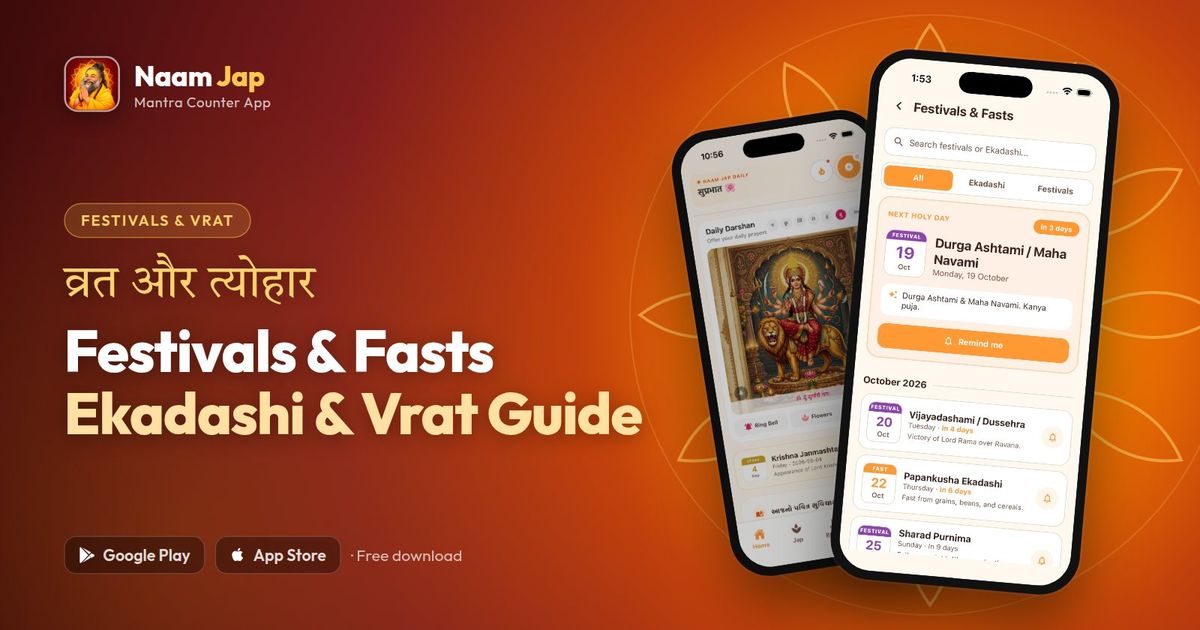
For example, in 2026 Vijayadashami (Dussehra) falls on 20 October and Sharad Purnima on 25 October in most North Indian calendars. Many festivals also have a special mantra — see Om Namah Shivaya for Shivaratri and Ram Naam Jap for Ram Navami and Dussehra.
Never miss a holy day with the Naam Jap app
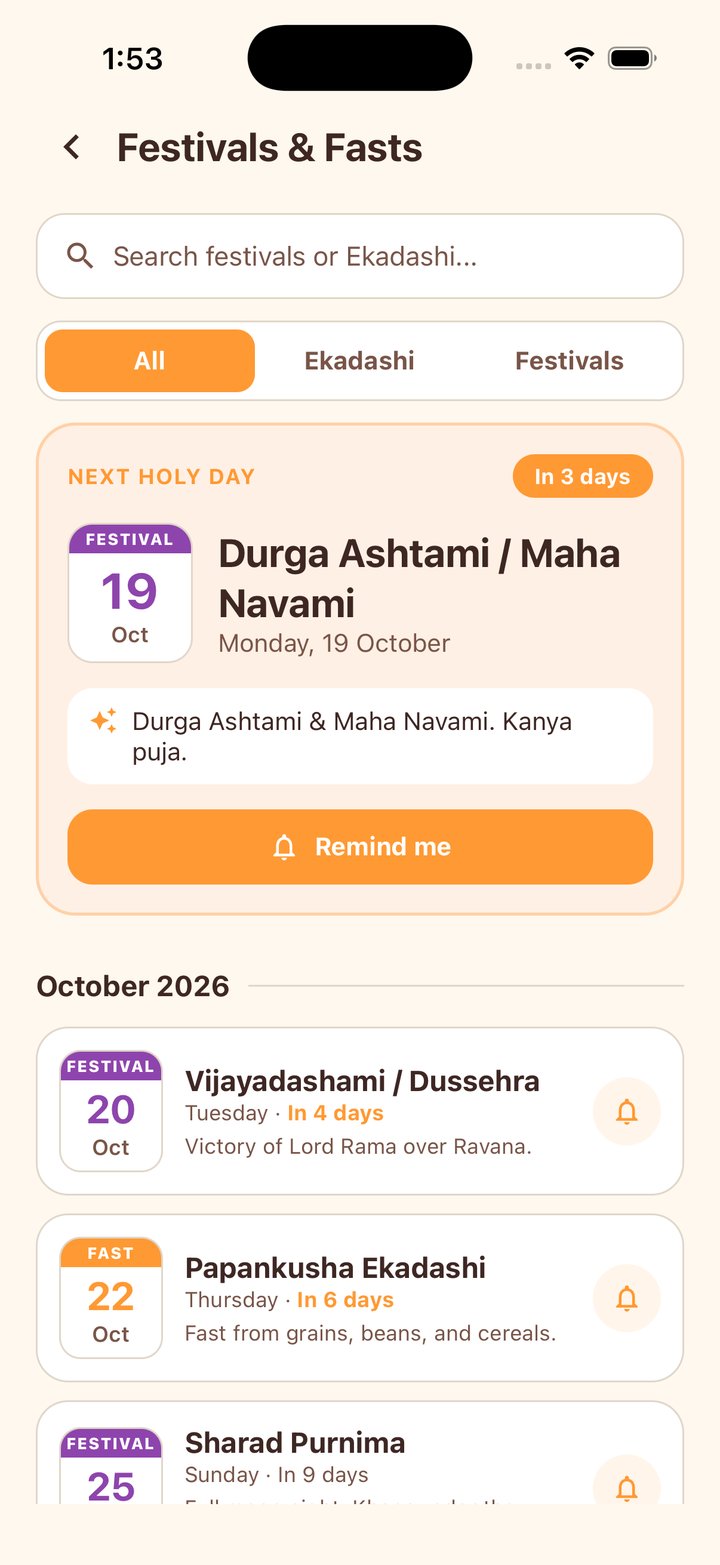
- Next holy day: see the upcoming festival or fast with a countdown such as "In 3 days".
- Month-wise list: every festival and fast with its date, weekday and a one-line meaning.
- Filter and search: switch between All, Ekadashi and Festivals, or search for any festival.
- Remind me: tap the bell to get a reminder before the day arrives.
Make each festival part of your sadhana
- Plan ahead: set a reminder a few days before so you can prepare.
- Take a sankalp: festivals like Navratri and Kartik are ideal for a jap vow — see how to take a Naam Jap sankalp.
- Read the festival's story: it deepens the meaning — explore Hindu stories with moral lessons.
- Chant at the right time: see the best time for Naam Jap.
Frequently asked questions
How many Ekadashis are there in a year?
Usually 24 — two in every lunar month, one in the waxing (Shukla) fortnight and one in the waning (Krishna) fortnight. In a year with an extra month (Adhik Maas) there are 26.
What can I eat on an Ekadashi fast?
Traditionally grains, beans and cereals (such as rice, wheat and dal) are avoided. Many people eat fruits, milk, nuts and permitted foods like sabudana, potatoes or kuttu. Some keep a stricter waterless (nirjala) fast. Follow your family tradition and health needs.
Why do Hindu festival dates change every year?
Most Hindu festivals follow the lunar calendar (tithis), not the solar Gregorian calendar. Because a lunar year is about 11 days shorter than a solar year, festival dates move each year, and an extra lunar month is added roughly every three years to keep the seasons aligned.
Why do different calendars sometimes show different dates?
Tithis begin and end at different clock times, which depend on location and sunrise. Regional traditions also name months differently. That is why a festival may fall on different days in different panchangs — check your local panchang or temple.
Ready to start your practice?
Free mantra counter for your daily Naam Jap — rated 4.6★ on Google Play.