For thousands of years, Indian families have passed on wisdom through stories — told by grandparents, sung in temples and read from the scriptures. These Pauranik katha are short, memorable and full of lessons that still guide everyday life. Here are eight of the most loved, with the lesson each one teaches.
1. Shiva drinks the poison and becomes Neelkanth
During the Samudra Manthan, the devas and asuras churned the cosmic ocean using Mount Mandara as the churning rod and the serpent Vasuki as the rope, hoping to obtain amrit. Before the nectar appeared, a terrible poison called Halahala rose up, threatening all of creation. Lord Shiva drank it to save the world. Mata Parvati held his throat so the poison would not go further, and it turned his throat blue. Since then he is lovingly called Neelkanth.
Lesson: true greatness is taking on hardship to protect others.
2. Radha and Krishna's divine love
Celebrated in the bhakti tradition and in poetry such as Jayadeva's Gita Govinda, the love of Shri Radha and Krishna is not about possession but about pure, selfless devotion. Radha is seen as the perfect devotee, whose every thought rests on Krishna.
Lesson: real love gives without expecting anything in return. Read more in Radha Naam Jap: meaning and method.
3. Bharata waits for Rama
When Shri Ram was sent to the forest for fourteen years, his brother Bharata refused the throne that had been arranged for him. He went to Chitrakoot and begged Ram to return. When Ram insisted on keeping his father's word, Bharata took Ram's padukas (sandals), placed them on the throne and ruled Ayodhya only as a caretaker, living simply at Nandigram until Ram came home.
Lesson: devotion and duty matter more than power.
The throne was empty, yet the kingdom was full — because love ruled in Ram's name.
4. Shiva burns Kamadeva
The demon Tarakasura could only be defeated by a son of Shiva, but Shiva was absorbed in deep meditation after the loss of Sati. The devas sent Kamadeva, the god of desire, to stir Shiva's heart. When Kamadeva's flower arrow disturbed him, Shiva opened his third eye and Kamadeva was burnt to ashes. Moved by the grief of Kamadeva's wife Rati, Shiva later blessed him to live on without a body, as Ananga.
Lesson: mastery over desire is a source of great inner strength.
5. Parvati's tapasya
Mata Parvati was determined to win Shiva as her husband — not through beauty or force, but through tapasya (austerity). She meditated through heat, cold and rain, and is said to have given up even leaves, which is why she is also called Aparna. Pleased by her devotion, Shiva accepted her, and their son Kartikeya later defeated Tarakasura.
Lesson: patience and steady effort can achieve what seems impossible.
6. Hanuman carries the Sanjeevani mountain
In the battle of Lanka, Lakshmana was gravely wounded. The healer Sushena said only the Sanjeevani herb from a Himalayan mountain could save him before sunrise. Hanuman flew to the mountain, and when he could not recognise the herb, he lifted the entire peak and carried it back. Lakshmana was saved.
Lesson: when your purpose is pure, no obstacle is too big. Many devotees remember Hanuman ji with Ram naam.
7. Nachiketa and Yamraj
In the Katha Upanishad, the young boy Nachiketa goes to the abode of Yamraj, the lord of death. Pleased by his patience, Yama offers him three boons. Nachiketa refuses wealth and pleasures and asks instead what happens after death. Yama teaches him the knowledge of the eternal Self (Atman).
Lesson: seek lasting truth over temporary pleasures.
8. Kalki — the avatar of the future
The Puranas describe Kalki as the tenth avatar of Lord Vishnu, foretold to appear at the end of the Kali Yuga, riding a white horse and wielding a sword, to end adharma and begin a new age of truth.
Lesson: however dark the times, dharma is protected and goodness returns.
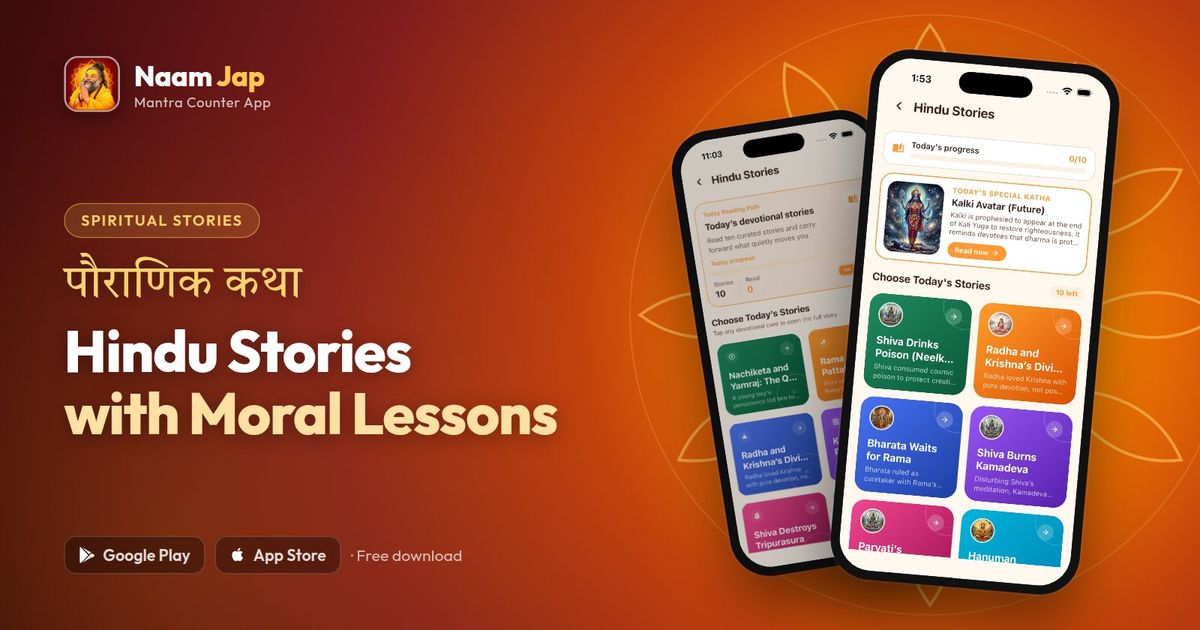
Read Hindu stories daily in the Naam Jap app
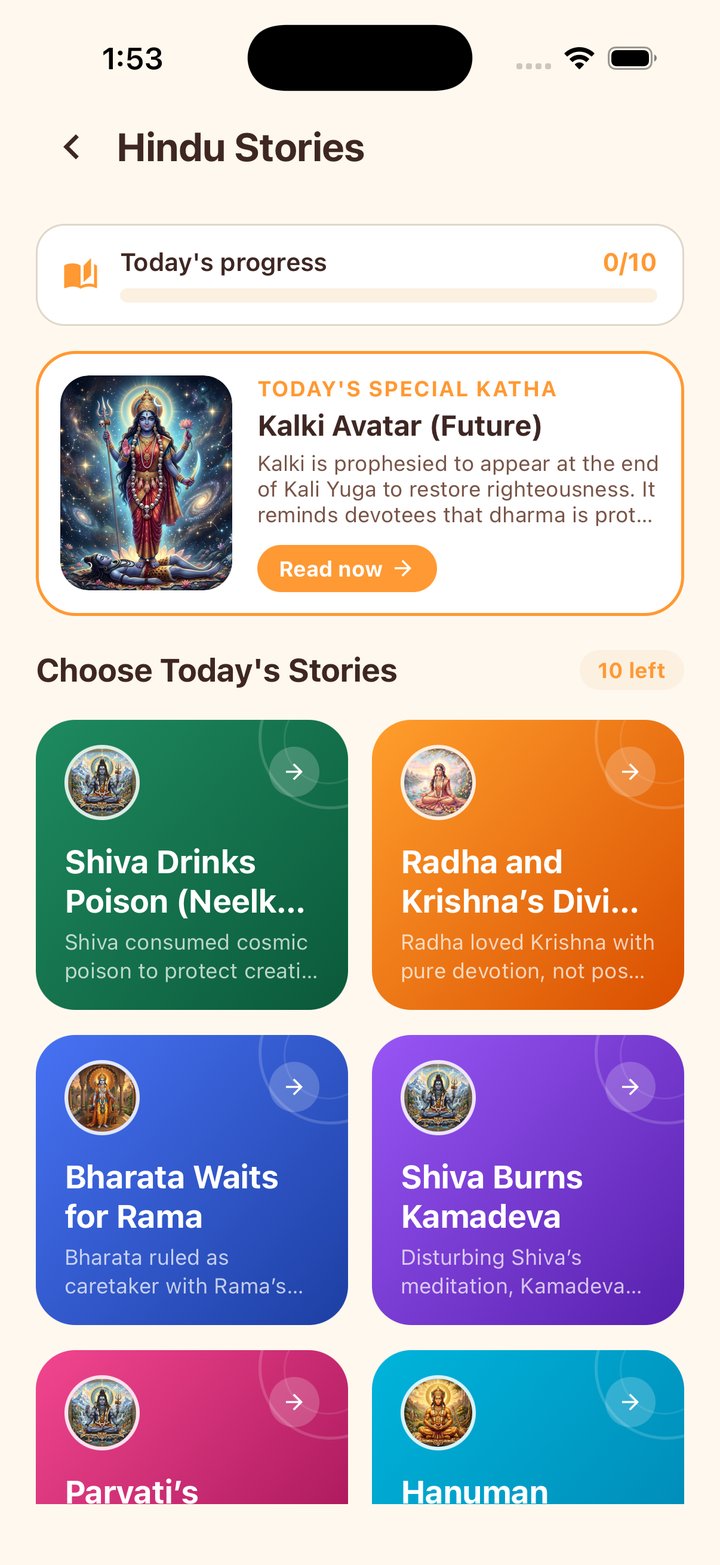
- Today's Special Katha: one featured story each day with a short summary and a "Read now" button.
- Choose Today's Stories: colourful cards for stories of Shiva, Radha-Krishna, Rama, Hanuman, Parvati and more.
- Today's progress: a progress bar shows how many of today's stories you have read.
How to make stories part of your sadhana
- Read one story after your jap: it keeps the mind in a devotional mood.
- Share with family: read aloud to children at bedtime.
- Reflect on the lesson: pick one value from the story to practise that day.
Pair your reading with a steady chanting routine — start with What is Naam Jap? or take a vow with a Naam Jap sankalp.
Frequently asked questions
Why is Lord Shiva called Neelkanth?
During the churning of the ocean (Samudra Manthan), a deadly poison called Halahala emerged. Shiva drank it to protect the world, and it stayed in his throat, turning it blue. "Neelkanth" means "the blue-throated one".
Where do these stories come from?
They come from Hindu scriptures such as the Ramayana, the Mahabharata and the Puranas (for example the Shiva Purana and Bhagavata Purana), as well as the Upanishads. Details can differ slightly between texts and regional traditions.
Are these stories good for children?
Yes. Short stories like these are a gentle way to teach children values such as courage, devotion, honesty and self-control. Reading one story a day together can become a lovely family habit.
Where can I read Hindu stories every day?
The Hindu Stories section of the Naam Jap app offers a daily special katha and a set of short devotional stories to read each day, with a progress bar for today's reading.
Ready to start your practice?
Free mantra counter for your daily Naam Jap — rated 4.6★ on Google Play.